Although large language models have made major advances in professional capabilities, an important dimension of intelligence is still missing: the ability to understand human emotion. Today’s AI assistants can provide accurate answers, but they rarely create the deep connection associated with a friend or caregiver. Education, mental-health support and companionship increasingly require warmer interaction from machines.
Training-data quality is another long-standing bottleneck. Industry estimates suggest that a substantial share of general-purpose AI training data is noisy or of limited value. Collecting and filtering high-quality emotional data is therefore becoming essential to the next stage of emotional intelligence. GAEA aims to address this problem through a decentralized AI training network that incorporates human emotional data.
What is GAEA?
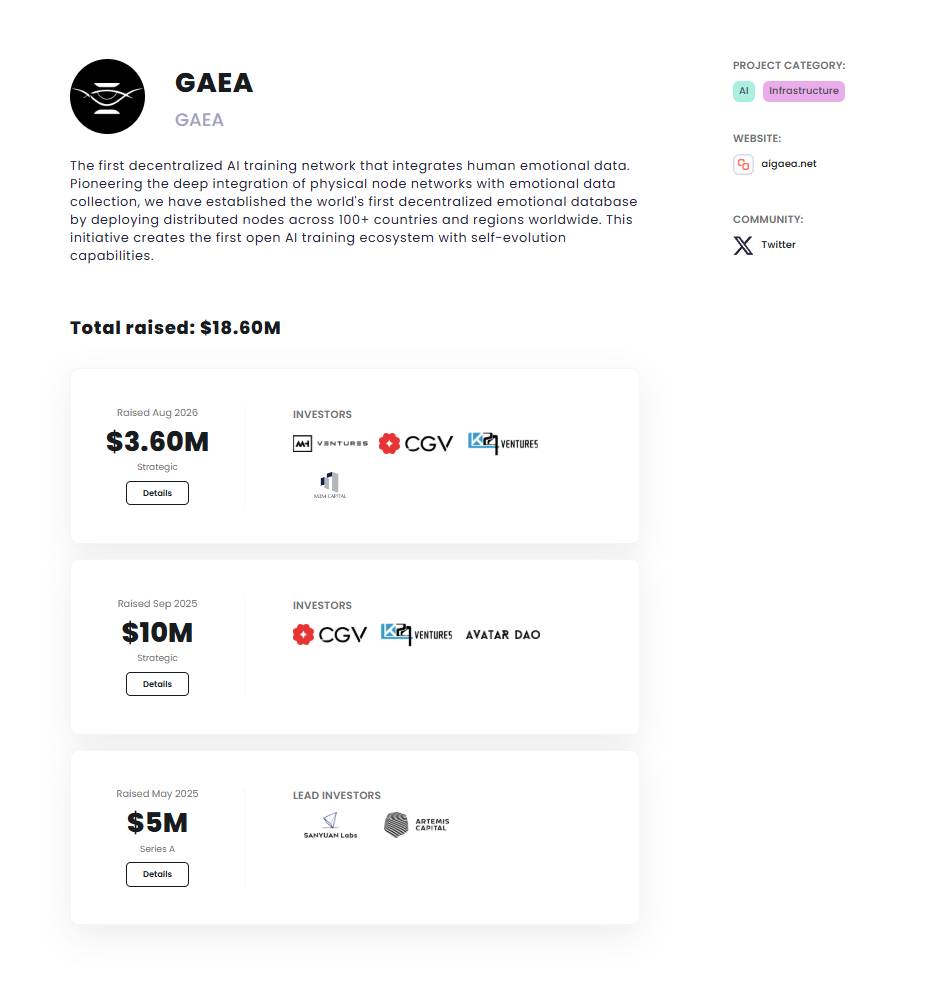
GAEA is a decentralized AI training network developed by GAEA Labs, part of the Gaea Foundation. The project positions itself as an emotional infrastructure layer for AI, with a decentralized ecosystem connecting people, AI agents, data and computing power.
GAEA combines a network of physical nodes with emotional-data collection. According to the official documentation, distributed nodes operate across more than 100 countries and regions, forming a decentralized emotional database. By the end of August 2026, the ecosystem reportedly had more than 850,000 users.
GAEA’s goal is to turn emotional data into measurable, verifiable and valuable productive inputs that help AI models understand people more closely. The project is also developing GAEA Certification, a framework for assessing whether a model or application has verifiable emotional capabilities.
What makes GAEA different?
Unlike many AI projects focused only on emotion recognition, GAEA uses personality as an intermediary for emotional learning. The team says this approach can reduce the computing required to learn human emotions, lower development barriers and make interactions more natural.
A second difference is its trust and valuation layer. GAEA is building a market for multimodal emotional-data factors. After quality screening, emotional data is packaged as a verifiable capability and valued according to measurable business improvements such as customer satisfaction, user retention or operating costs.
The third distinction is a device-first architecture. Most emotional signals are processed on users’ devices to protect privacy instead of sending all raw data to centralized servers.
GAEA architecture and operation
GAEA follows a device–edge–cloud–blockchain model. Its core component is the Godhood Engine (GE), which the project’s official whitepaper describes as the infrastructure for trust, certification and settlement.
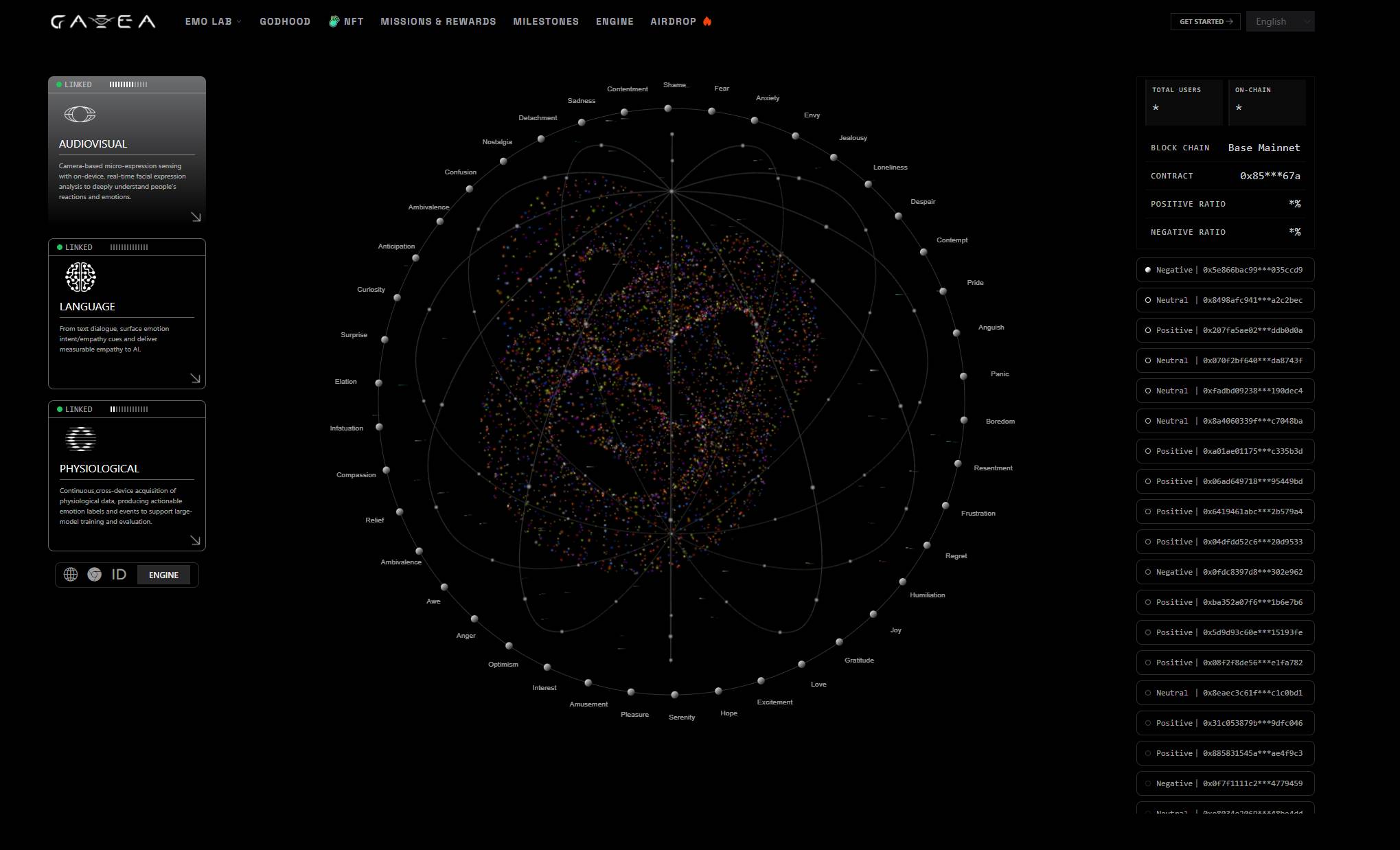
- Sensing and consent: embedded tools collect multimodal signals including facial expressions, emotional and empathic cues in language, and wearable-device data. Filtering, denoising and feature extraction take place on the device.
- Edge collaboration: inference and temporary storage occur at the edge, which also coordinates federated learning and secure aggregation.
- GE capability layer: a quality process screens data before multimodal training and produces emotional-capability levels with defined validity limits.
- Value and trust layer: GAEA Certification and verifiable credentials package evidence of capability, while the Value Data Layer maps practical improvements to valuation and benefit sharing.
- On-chain: smart contracts on Base Mainnet record, reconcile and settle activity connected with multimodal emotional-data training.
- Off-chain: sensitive processing—including feature extraction, model training and federated-learning coordination—remains outside the blockchain. The project says it combines federated learning, differential privacy and trusted execution environments.
Products in the GAEA ecosystem
- Godhood Engine: the core spanning devices, edge, cloud and blockchain, providing trust, certification and settlement.
- Godhood ID: a user identity connected to the Godhood Engine through the Awaken, Map and Crown capabilities.
- EMOCOORDS: an emotional-coordinate system and group of AI agents that treats personality as an intermediary in emotional learning.
- DECISIONS: an ethical-simulation component that turns value preferences and risk appetite into a trainable decision profile.
- Smart devices: the Gaea Psyche wearable line is intended to extend personality, emotion and decision-making capabilities into the physical world and remains in testing.
- GAEA Certification: a framework for evaluating whether a model or application has verifiable emotional capabilities.
Project token utility
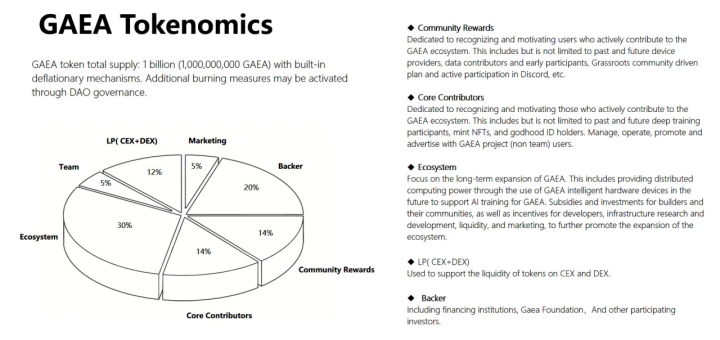
- Contribution incentives: rewarding users who provide emotional data, resources and other network contributions.
- Governance: enabling community participation in selected ecosystem and incentive decisions.
- Value distribution: connecting value created by data and network activity with contributors.
Conclusion
GAEA addresses a genuine weakness in today’s AI: models can process language impressively, yet still struggle to understand the emotional context behind it. The project’s combination of local data processing, decentralized infrastructure and verifiable capability standards is an interesting direction, particularly where sensitive emotional data is involved. Its long-term value, however, will depend less on ambitious terminology and more on whether GAEA can demonstrate that its approach measurably improves real AI products while protecting users’ privacy.